
The Civic’s Sacred Ring: Filipino Fighters and the Heart of San Francisco
By Emmanuel Rivera, RRT
PhilBoxing.com
Mon, 14 Apr 2025
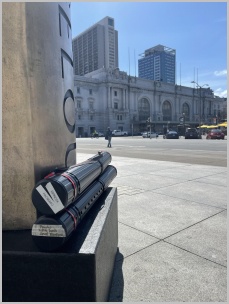
The Bill Graham Civic Auditorium, once the San Francisco Civic, stands tall at 99 Grove Street—a quiet giant nestled in the city’s civic core. Time has worn its walls, but the building still breathes. For those who know and remember, it remains one of the last sacred spaces in American boxing.
Etched in one of its front walls is this:
ERECTED AND PRESENTED TO-THE CITY OF SAN FRANCISCO -BY THE PANAMA- PACIFIC INTERNATIONAL EXPOSITION~ ANNO DOMINI MCMXIV
For us non-Latin speakers, it said “In the Year of Our Lord 1914.”
Perhaps, it is the oldest surviving venue in the country (and the world, last checked) that still opens its doors to boxing, indoor sport, and spectacle.
It’s a place where champions once bled and legends were born. Filipino fighters, especially, lit up the ring here—not just with fists, but with fire.
The last of the greatest Filipino boxers before WW 2 fought at The Civic.
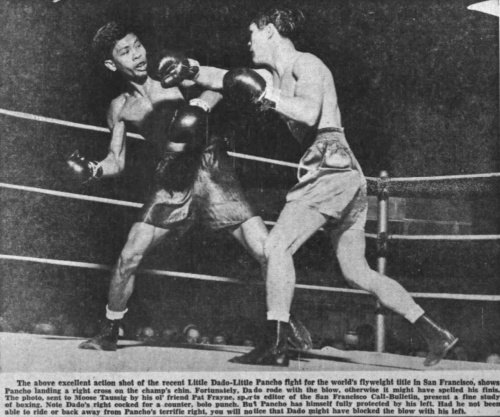
Caption: The above excellent action shot of the Little Dado-Little Pancho fight for the world's flyweight title in San Francisco, shows Pancho landing a right cross on the champ's chin. (Source: Honolulu Star-Advertiser (Honolulu, Hawaii) • Mon, Jul 1, 1940 • Page 10
On June 17, 1940, Eleuterio Togonon Zapanta- aka Little Dado- and Eulogio Villaruel Tingson- aka Little Pancho- two Filipino tough guys from Negros Occidental in the Philippines, stood across from each other for the fifth time in this very auditorium.
Dado walked in as world flyweight champion (California State Version). Pancho had beaten him before—three times, to be exact. But this wasn’t just a rematch. It was the match. Filipino and American flags waved from every corner of the building. The crowd buzzed with something more than sport. This was identity. This was pride.
Dado stayed calm, rolled through Pancho’s fast start, and did just enough to keep his belt. The referee called it a draw. The papers split on who won. The crowd argued, but no one left disappointed. Dado kept his title. Pancho kept his honor. Both kept the crowd.
Decades later, on November 10, 2001, the Civic came alive again. Manny Pacquiao stepped into the same ring where Dado and Pancho once danced. He faced Agapito Sanchez. It was a gritty, frustrating fight that ended in a technical draw. But for those watching, something was unmistakable—another Filipino had arrived, and the lineage was intact.
I was present that night, not yet a writer, but already a believer. With me were two of my oldest friends— Rudy Teodosio and Tom Macasaet— fellow respiratory therapists and fans of the fight game. We knew what we were seeing, even if we couldn’t yet put words to it. A torch was being passed.
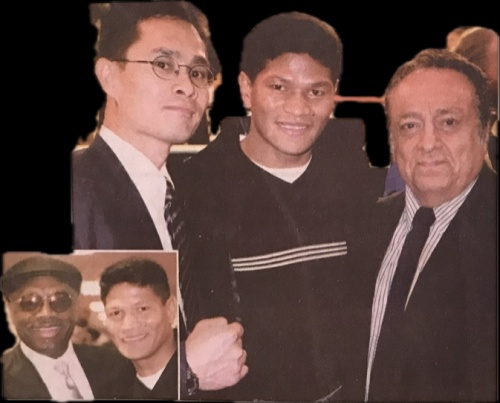
That evening, I had the chance to meet WBC President Jose Sulaiman and San Francisco Mayor Willie Brown. Both spoke of Luisito Espinosa with great respect— the kind that doesn’t get handed out lightly. But what stays with me most is what happened in the locker room. Luisito, quiet and gracious, introduced me to Mr. Pacquiao. No crowd, no ceremony. Just a handshake. A nod. A moment.
Later, I told my father, Hermie Rivera, and his friend Jack Fiske what it had meant.
My father then said something I’ve always kept: “There will come a time when you find yourself where Philippine boxing began… and you will see the deep reason the stories of the great Filipino fighters need to be remembered and retold.”
He was right.
Back in March 2024, I stood at the old site of the Olympic Stadium in Santa Cruz, Manila. Avenida Rizal, once the city’s pulse, now moved to a different rhythm. The stadium was gone, paved over, absorbed into the chaos of progress. But if you listened closely, the echoes were still there— rising from the sidewalk like a ghostly bell before the first round.
I thought of the Sabado (Saturday) nights it must’ve hosted. Kid Dencio, Pancho Villa, Speedy Dado. The fans. The roar.The gamblers’ prayers.
Not long after, I stood again at 99 Grove Street. This time, with my editor Mr. Dong Secuya. As we walked the streets of San Francisco nearing the fabled arena, Mr. Secuya paused, then said something profound: “Market Street must have been like (San Francisco’s) Avenida Rizal.”
He was right.
Both streets were once arteries of their cities. Both carried fight posters, vendors, noise, and anticipation.
Avenida Rizal had the Olympic Stadium.
Market Street had the Civic Auditorium.
You could almost feel the spirits greeting each other across the Pacific.
Mr. Secuya, the founder of the greatest boxing website called PhilBoxing.com, was remembering, honoring, and drawing a line between places that mattered to people like us— those who understood boxing not just as sport, but as a shared memory. A form of prayer. A kind of truth.
That afternoon felt full circle. I understood then that I wasn’t just chasing stories. I was standing on sacred ground, in both cities. Places where our fighters had fought not only for titles, but for dignity and the right to be seen.
The Civic Auditorium wasn’t just home to Filipino champions. It was a proving ground for boxing’s elite.
Bobo Olson defeated Norman Hayes here in 1952. Charley Burley beat Oakland Billy Smith here in the mid-1940s. Eddie Booker fought Holman Williams in this very ring in 1944.
Sugar Ray Robinson defended his middleweight title here in 1952 with a 15-round decision over Hawaiian-born and SF native Carl Bobo Olson.
The Civic Auditorium still stands. Still hosts. Still shines. And maybe—just maybe—it inspired Frank Churchill when he built the Olympic Stadium in Manila back in 1919. Churchill, after all, visited San Francisco often. He knew Solomon Levinson, the legendary boxing glove maker whose name reverberated in both cities.
I like to think the Civic helped shape that dream in Manila. That it offered a blueprint for what boxing could be—grand, public, electric. We do know Levinsons’ boxing gloves most likely did.
Now, both boxing arenas live on in memory. One still stands. One does not. But the stories— they remain.
As I continue along this path— part witness, part student of the ring— I carry with me those quiet moments: a handshake with Manny, a chuckle with Tom, Rudy and Louie…a pause beside Mr. Dong Secuya, and my father’s voice resonating still. The roar that once rose from the Civic. The silence where the Olympic Stadium once stood. These are more than memories. These are the stories I’ve been shaped by—and feel called to honor.
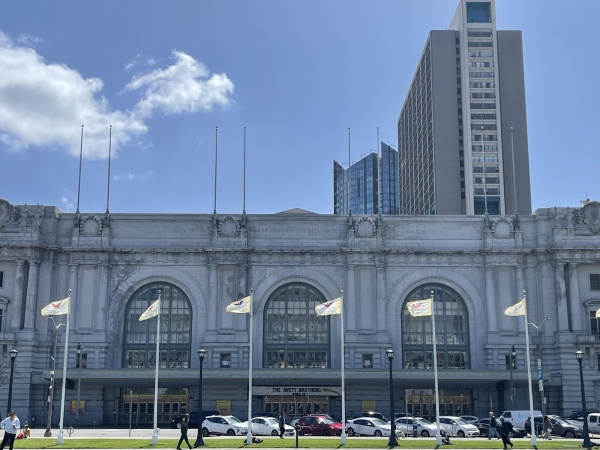
The Bill Graham Civic Auditorium in San Francisco, CA.
Click here to view a list of other articles written by Emmanuel Rivera, RRT.
Recent PhilBoxing.com In-House articles:
GARNICA VS. CORREA SET FOR WBC CONTINENTAL AMERICAS TITLE CLASH IN LONG BEACH MAY 15
Wed, 15 Apr 2026IBA Board of Directors convenes for strategic April 2026 meeting
Wed, 15 Apr 2026Cadalso to turn pro in Juego Todo
By Lito delos Reyes, Wed, 15 Apr 20262-Time World Champion Shawn Porter Confirmed for Ninth Annual Box Fan Expo, During Cinco De Mayo Weekend, Saturday May 2 in Las Vegas
Wed, 15 Apr 2026Former Coach of De La Salle University Taft-Manila finishes third place in Beijing Blitz Grand Prix
By Marlon Bernardino, Wed, 15 Apr 2026"When one goes to war we all go to war!" – Owen Corrigan challenges Mad Dog Micah Rivetti for Light Heavyweight title May 29 in Perth – Thunderdome 54
Tue, 14 Apr 2026Crocs FC wins 3 titles in Football sa Bayan
By Lito delos Reyes, Tue, 14 Apr 2026Chess Kings Ready to Battle in Pacquiao 3x3 Chess Team Tournament at Lica Malls 500 Shaw
By Marlon Bernardino, Tue, 14 Apr 2026Manguyab to debut in RFL
By Lito delos Reyes, Tue, 14 Apr 2026Simsri Crushes Mendoza, Retains IBF 108-lbs Title; Could A Filipino Challenger Fight Simsri Next? (Analysis)
By Carlos Costa, Tue, 14 Apr 2026Manny Pacquiao and Jas Mathur via Manny Pacquiao Promotions Announce Nine-Figure Team Boxing League Partnership, Launching Manny Pacquiao’s San Diego TJ’s Franchise
Tue, 14 Apr 2026Pabular loses by a split decision
By Lito delos Reyes, Tue, 14 Apr 2026DFBC dominates in Invitational Doubles
By Lito delos Reyes, Tue, 14 Apr 2026Santisima Faces Undefeated Grigoryan for IBF Asia Title in Russia
Tue, 14 Apr 2026Jenn Perella excited to be fighting in front of family & friends on ‘Rumble at the Rink II’
Tue, 14 Apr 2026